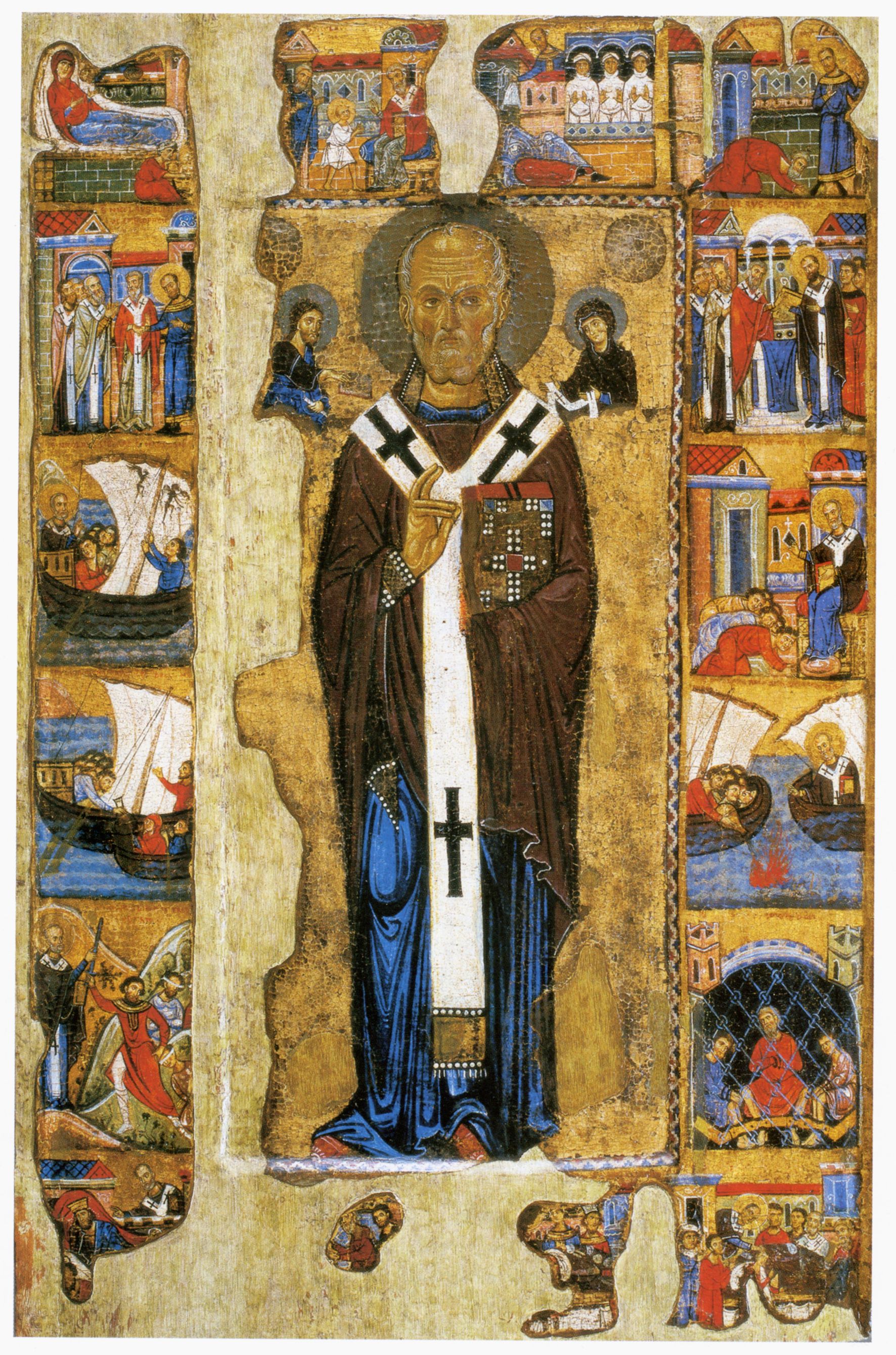
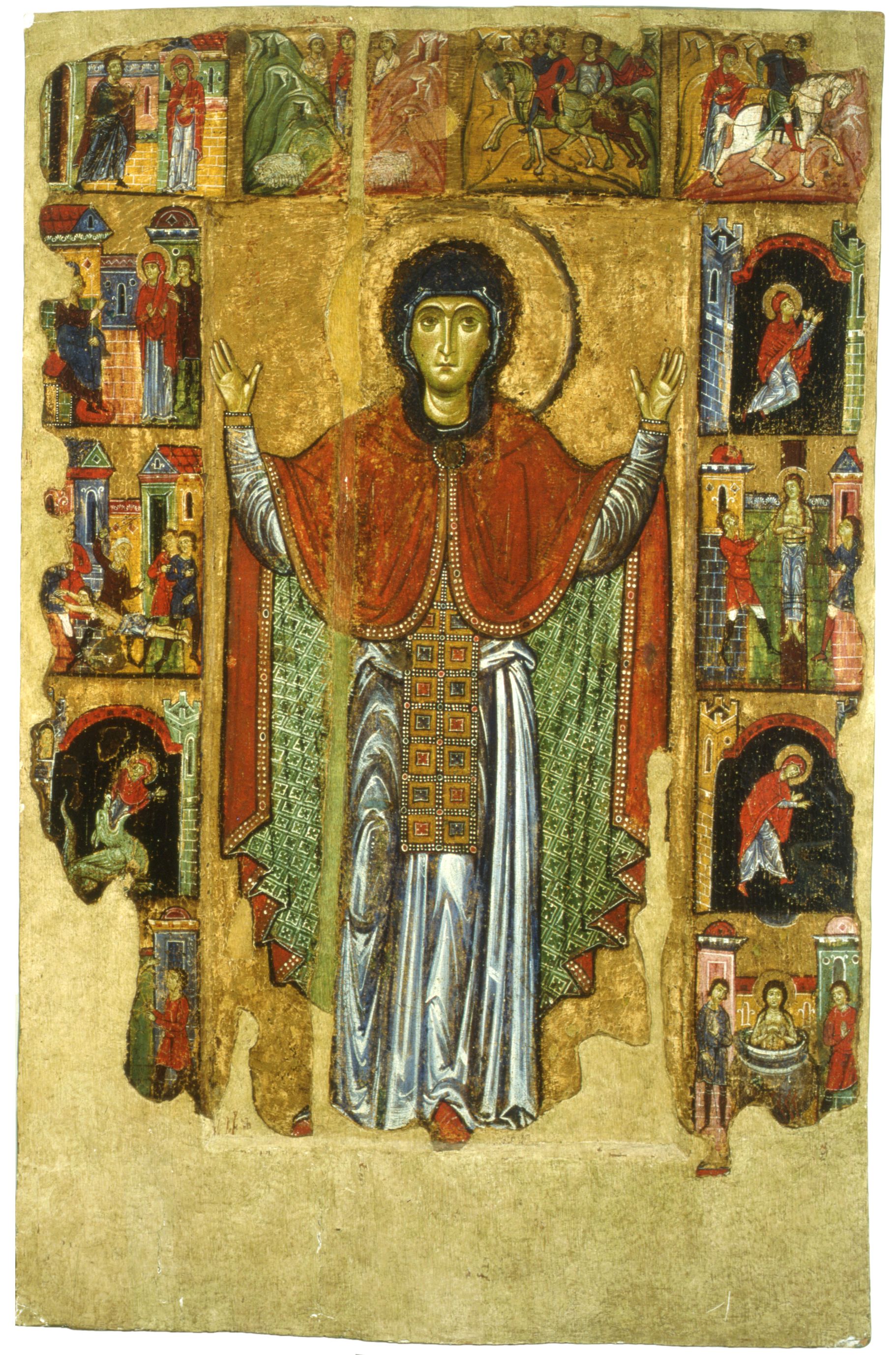

The panel, together with the twin with San Nicola (Cat. II. 3) and the Madonna with Child (Cat. II. 9), comes from the noble church of Santa Margherita di Bisceglie, of the noble Falcone family, in which it is remembered, but not on the altar, until the 1920s. Passed with the church to the Sifola, to the Frisari and finally to the Berarducci counts, it was purchased in 1963 by the Province of Bari for the Pinacoteca, which it promoted. Never subjected to a complete restoration but only to conservative and light cleaning interventions, it has suffered irreparable damage especially in the lower part, where the color has fallen, exposing the primer or at times the support, and along the left side margin, strongly incomplete . Showy cracks cross it longitudinally at the junctions of the three boards of which it is made, stopped only by two rough crosspieces nailed to the back. The gold background is incomplete and integrated in several points. On the iconographic level, the panel closely resembles that of San Nicola, of which it was alternatively considered a model or derivation. Here we will limit ourselves to considering them twins, however rejecting the hypothesis that they originally formed a diptych. The setting is similar, with the holosome figure of the Saint, rigidly frontal, lowered with respect to the high edge that acts as a frame. The prayerful position gives maximum prominence to the princely attire: a red cloak with reseda green lining embellished with a diagonal lattice motif, stopped at the neck by a brooch and edged with two rows of small pearls, which the open and raised arms open in two handles on a blue tunic vigorously highlighted in white enriched by a jeweled stole; the tips of the red shoes come out from the hem of the robe; the head is enclosed in a dark blue cap; the features of the face are decidedly marked and plastically detected by strong brushstrokes, without subtleties of transitions. Unlike in the San Nicola, the very large nimbus is raised from the bottom. The explanatory writings of the scenes are missing, which are arranged along the high raised edge that serves as a frame. The story of Marina, an Antiochian virgin and martyr, who became Margaret in the Latin translation of the Passio, unfolds in chronological order with a trend of reading by registers, from left to right, from top to bottom.