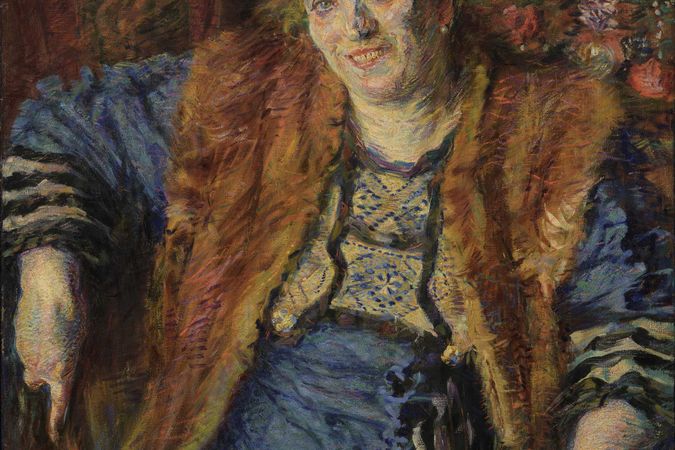
In contact with the fervent environment of artists and intellectuals who at the beginning of the century animated Genoa and the whole of Liguria, opening it to recent national and foreign innovations, Cornelio Geranzani approached Divisionism around 1907 immediately reaching original results. In the years immediately following Geranzani conducts his divisionism in the direction of geometric abstraction, characterizing it with a coarse pointillism that progressively becomes pure decorative code, in a pictorial ensemble now reduced to a two-dimensional mosaic. The lumino, ascribable to 1910, is one of the major results of this first production still linked to Divisionism, which the artist has neglected since 1916 for a return to volumes close to the twentieth century. The painting attempts an imitation of the propagation phenomena of electric light in an urban context. The pivot of the composition is the circumference of the lit lantern, from which the weft of the signs departs with a centrifugal trend to invade the surface of the canvas simulating the expansion of the light beams. The structural rigor, aided by the choice of an intrinsically regular view and the chromatic synthesis, able to enhance the potential of the combination of primary colors, make Il lampione one of the cornerstones of the Genoese's painting, which arrives at a vision that is both rational and impactful expressionistically.


The work "The candle" by Cornelio Geranzani is kept at Pinacoteca il Divisionismo, in Tortona.
"The candle" is a work by Cornelio Geranzani from 1910 - 1915 made with the technique "Oil painting on canvas".
You can admire the work in the collection of Pinacoteca il Divisionismo. Check opening hours and access details on the museum page on Artsupp.