From 22 December to 5 March 2026
Accepted the Artsupp Card


In the second half of the 19th century, running a business, practicing a skilled trade, or, least of all, being an alpinist was far from easy if you were a woman. Photography—considered “dangerous” for the chemical processes involved and the weight of the equipment to be carried—and mountaineering were primarily male domains. In the early days, mountaineering and mountain photography were accessible mainly to confident, financially independent women from the upper middle class or nobility. Photos by women documenting their alpine adventures were often published under pseudonyms: the names of their husbands. Many female photographers worked in their husbands’ labs, and aside from running occasional ads in regional newspapers promoting their craft, women photographers such as Martha Attinger in Neuchâtel, Switzerland, Hanni Bernhard, or Rose Marie Schudel-Ingold remained virtually unrecognized.
The first famous female mountain photographer was probably
Franziska Möllinger (1817–1880) from Trier, Germany, who had come to Solothurn,
Switzerland, with her family in 1836. As early as 1844, she produced
daguerreotypes of the Bernese Oberland region in Switzerland and sold them as
lithographs. One of the first women in mountain photography to match Vittorio
Sella’s mountaineering and photography skills was Baroness Giulia
de Rolland (1842–1929). In
1893, she contributed to a mountain photography exhibition which also featured
Vittorio Sella. While Sella won the gold medal, she earned bronze and received
a mention in the CAI (Club Alpino Italiano) publications. However, none of her
photos have survived. Many early alpinists, including Amelia Edwards (1873:
“Untrodden Peaks and Unfrequented Valleys”), Elizabeth Fox Tuckett (1871:
“Zigzagging amongst Dolomites”), and Hermine Tauscher-Geduly (1843–1923), used
their photos to illustrate detailed reports of their mountain tours. The
period between 1865 and 1914 saw numerous wives of photographers active in
mountaineering and mountain photography, and it would not be possible to
include them all in this exhibition. Instead, four women photographers were
selected to represent the group in this exhibition. Among them, Elizabeth
Whitshed Main takes a special place as an outstanding photographer, alpinist,
and the founder of winter alpinism in general and winter tourism in the region
of Engadin, Switzerland, in particular. The exhibition also features works by
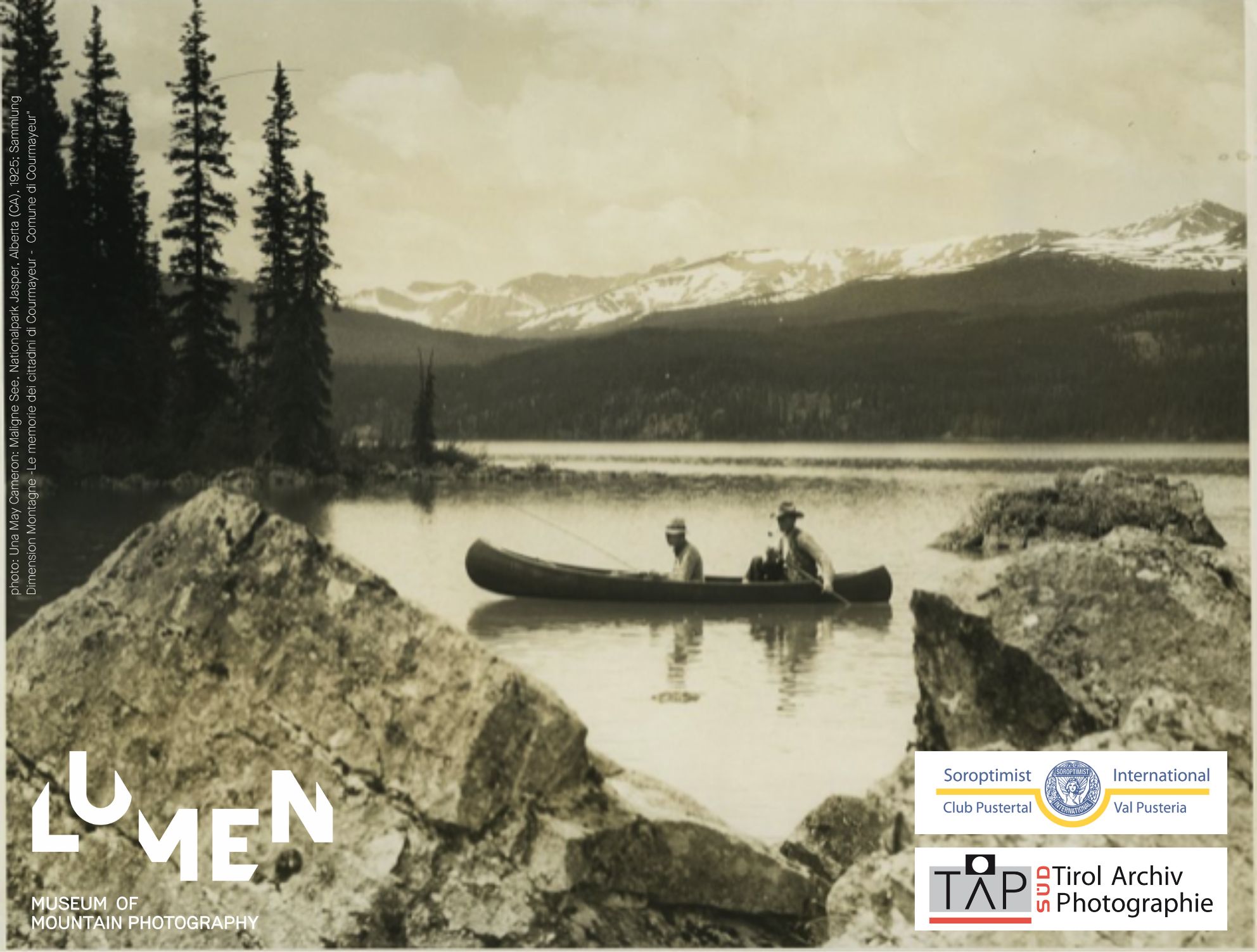
Gertrude Bell, Eleonore Noll-Hasenclever, and Una Cameron, three distinguished
alpinists, travel journalists, and women’s rights activists.
The life and work of these four pioneers of mountain photography are exhibited
in rotation.
Gertrude Bell (Gertrude Margaret Lowthian Bell)
1868 in Washington Hall (County Durham, United Kingdom) – 1926 in Bagdad (Irak)
Alpinist, archeologist, and diplomat
Born into a British industrialist family, Gertrude Bell came to Switzerland around 1901, which inspired her enthusiasm for mountaineering. She went on to become one of the best and bravest alpinists of the early 1900s. She climbed the Matterhorn and the Engelhörner range, one of whose peaks was named “Gertrudspitze” after her in recognition of her first ascent. Her attempt of the Finsteraarhorn failed due to inclement weather, forcing her to bivouac overnight on the mountain’s east face, but made her famous in alpinist circles.
She undertook numerous travels to Turkey, Kurdistan, and the Middle East, explored the lost culture of Mesopotamia, and served as an important diplomat for the Crown before and after the First World War, playing a key role in the nation-building of what would eventually become Iraq. These accomplishments have caused her to be considered the female equivalent of Lawrence of Arabia.
Gertrude Bell photographed her alpine endeavors undertaken together with the guides Heinrich and Ulrich Fuhrer in Switzerland in 1901/1902 and was equally enthusiastic about the mountains in the Middle East (Kurdistan, Lebanon), which she also documented photographically.
Curator: Richard Piock (TAP – Süd)
An exhibition in cooperation with Soroptimist Club Pustertal and TAP - Süd

Kronplatz, 11, Brunico, Italy
Opening hours
| opens - closes | last entry | |
| monday | Closed now | |
| tuesday | Closed now | |
| wednesday | Closed now | |
| thursday | Closed now | |
| friday | Closed now | |
| saturday | Closed now | |
| sunday | Closed now |

Always

Thomas Biasotto - MASSIV
12.00 € instead of 17.00€