From 21 March to 27 September 2026


The elegance of the stroke, the charm of the composition, the depth of the themes addressed are some of the most recognizable characteristics of the art of Katsushika Hokusai (1760-1849).
From March 21 to September 27, 2026, the rooms of Palazzo delle Paure in Lecco will host an important exhibition dedicated to the Japanese master, titled "HOKUSAI. The secret of the Wave crossing Europe"
Curated by Paolo Linetti, director of the Museo d’Arte Orientale Collezione Mazzocchi in Coccaglio (BS), produced and realized by ViDi cultural and Ponte43, in collaboration with the Municipality of Lecco and the Sistema Museale Urbano Lecchese, the exhibition presents 43 works by Hokusai, documenting some aspects of his stylistic evolution, whose essence lies in analyzing and understanding nature to then transfigure it into something universal.
Lecco, a city of water, could only welcome an initiative that had as its main protagonist this natural element that plays a central role in Hokusai's production, an author capable like no other of capturing every nuance, from the roar of waterfalls to the crash of waves, and transforming it into the absolute protagonist of each of his works, a symbol of strength, change, and eternity. The exhibition also delves into Hokusai's adherence to Western classical canons, through the use of harmonic principles; this fact could explain the great success of Hokusai's works in the West, appreciated even by those with sensitivities and cultural and visual matrices distant from those of the Eastern world.
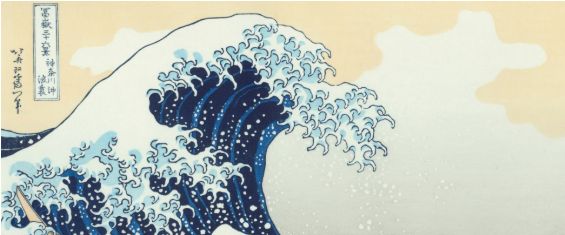
The exhibition path revolves around The Great Wave off Kanagawa, the most iconic and well-known masterpiece of the Japanese master and one of the most recognizable images in the world, which has fascinated both the unconscious of the Japanese and that of Westerners.
The compositional scheme of The Great Wave is analyzed and revealed, constructed using an architectural code on which to arrange lines, angles, and figures that the viewer's eye perceived as harmonious, balanced, and elegant. In particular, two geometric schemes are exhibited, found by Paolo Linetti in 2021, which the master used to build a large part of his works. These models are easily recognizable in his later creations and in drawings made with greater care, offering a unique key to understanding the genesis of his genius.
Throughout his artistic production, Hokusai will continue his quest to immortalize the perfect wave; at Palazzo delle Paure, it will be revealed how compositional details such as foam curls, foam, and masses of water evolve and transform over time.
Among the masterpieces exhibited at Palazzo delle Paure, the woodcut Whale Hunt published in the second volume of Hokusai's Album of Drawings from Life (Hokusai shashin gafu) stands out, depicting a dramatic whale hunt seen from the beach. The image is crossed by a taut rope that emphasizes the contrast between the strength of the whale and that of the fishermen. In the foreground, on the shore, one metaphorically witnesses the clash that takes place at sea between two contrasting waves: on the left emerges one reminiscent of The Boat in the Midst of Waves (1805), on the right, one that, in shape and foam, anticipates the famous Wave of Kanagawa.
Or, The Fuji Viewed from the Sea, a woodcut contained in the second volume of One Hundred Views of Mount Fuji, created between 1834 and 1835; in this case, the water takes on a monumental yet pacified dimension, abandoning the violence of its famous counterpart in Kanagawa, accompanying the viewer's gaze in a harmonious flow devoid of emotional tensions. The large mass of water culminates in foam that dissolves into fragments, evoking sandpipers, coastal birds that, according to legend, are born from the foam of the waves.
If the Wave of Kanagawa embodies a destructive force, The Fuji Viewed from the Sea depicts a constructive energy. The two images, in a way, complement each other: the first evokes the relentless power of nature, the second celebrates its harmonious magnificence.
The exhibition path is completed by a special section that tells of the extraordinary influence of Japanese art on Western artistic languages. From the mid-19th century, the passion for Japan spreads like wildfire throughout Europe, influencing the taste of the bourgeoisie in furnishings and fashion, as well as the eye of artists, attentive to the novelties introduced by the prints of the Japanese masters.
The comparison with Japanese aesthetics radically alters Western creativity, introducing revolutionary elements, with very important outcomes, in both applied arts and painting, from Monet to Whistler, from Van Gogh to Toulouse-Lautrec.
In the video room, a narrative and didactic video, curated by Simona Bartolena, will accompany the visitor in discovering Japonism in its various aspects. In the room dedicated to Japonism, an homage to Hokusai will be exhibited, a work by Armando Fettolini, an artist who has always looked to the floating world of Ukiyo-e as a source of inspiration.

Piazza XX Settembre, 22, Lecco, Italy
Opening hours
| opens - closes | last entry | |
| monday | Closed now | |
| tuesday | 10:00 - 14:00 | |
| wednesday | 10:00 - 18:00 | |
| thursday | 10:00 - 18:00 | |
| friday | 10:00 - 18:00 | |
| saturday | 10:00 - 18:00 | |
| sunday | 10:00 - 18:00 |
Closed from 2 May to the beginning of December